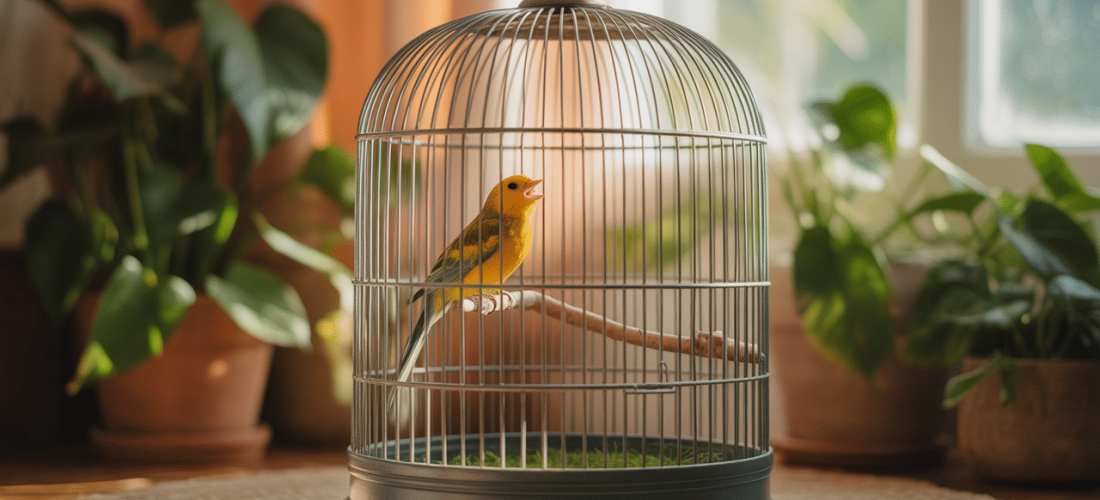
Birds are known for their melodious singing that delights nature lovers. But why do these creatures so free in the sky sing, even when they are in a cage? Understanding this vocal need goes far beyond simple artistic expression. It is a dance between their natural instinct and their confined environment.
Table of Contents
ToggleTerritorial instinct and reproduction
First of all, the singing of caged birds can be related to their natural instincts. In the wild, songs serve to mark a territory. A bird sings to say “This is my domain!” and to attract a female. Even in a reduced space, this instinct remains present. Males, in particular, cannot help but play this role, hoping to influence females in their presence.
This need to convey their message can also be a call for love. Even in a cage, a female can signal her presence through a song. Thus, cage singing is often an attempt at interaction, whether it’s to awaken the interest of a partner or to signal their existence to another.
Emotional well-being
Singing can also be considered a way to express emotions. Birds use their vocalizations to communicate their feelings, whether it is joy, stress, or loneliness. When a bird sings, it can release happiness hormones that bring it comfort. In a cage, singing then becomes a source of happiness, an escape from the daily routine.
Environmental stimulation
Another key factor is the caged environment. Cages can be monotonous and so little stimulating. Singing then becomes a reflex, a way to stimulate oneself. If the bird does not receive regular interactions, singing allows it to create a bond with its space. It gives it the impression that the outside world is closer, even without a real connection.
A cry to attract attention
Finally, among the reasons why caged birds sing, there is the need for attention. Often, owners react to their birds’ singing. This behavior reinforces the idea that singing can be a way to receive love and affection. Birds are social creatures that seek company. By singing, they attract human attention, hoping to create a bond and share their universe.
So, stripped of their natural habitat, these birds continuously use singing to build bridges between their inner and outer worlds. This raises an important question: does captivity really limit a bird’s ability to express itself fully?